There's a moment most hotel managers experience when staying at a competitor's property: you notice something. The way the front desk agent anticipates your needs. How housekeeping handles an unusual request. The confidence with which a night auditor resolves a billing issue without calling anyone.
It's not magic, and it's usually not about having better people or bigger budgets. It's about training what most hotels leave to chance.
Great hotels don't hope for good service, they engineer it. They train the details that average hotels assume employees will pick up through experience or intuition. The gap between these two approaches is the difference between consistent excellence and unpredictable quality.

Guest Greeting and First Impressions
What average hotels do: Tell employees to "be friendly" and assume they know what that means. Some agents are naturally warm and engaging. Others are efficient but cold. Service quality depends entirely on personality and mood.
What great hotels train: Specific greeting behaviors, such as eye contact within three seconds, using the guest's name twice during check-in, reading body language to adjust energy levels, asking open-ended questions to build rapport. They practice these behaviors until they become automatic, regardless of how busy or tired the employee feels.
The result? Every guest receives a consistent welcome that sets the tone for their entire stay. Training in effective communication and rapport-building removes the guesswork and ensures your team knows exactly how to create that critical first impression.
Front Desk Communication and Confidence
What average hotels do: Provide a quick walkthrough of the PMS and basic procedures. Employees learn by watching others and asking questions when they're unsure. Confidence develops slowly, through trial and error.
What great hotels train: Decision-making frameworks. How to handle pricing questions, upgrade requests, or policy exceptions without escalating to management. When to bend rules and when to hold firm. How to explain policies in a way that feels helpful rather than restrictive.
Scenario: A guest asks for a late 3 p.m. checkout. An untrained agent says, "I'll have to check with my manager." A trained agent says, "Let me see what I can do," checks availability, and either grants it confidently or offers a reasonable alternative like luggage storage and shower access.
The difference isn't authority, it's training. Great hotels teach employees how to think, not just what to do.
Service Recovery and Complaint Handling
What average hotels do: Tell employees to "get a manager if there's a problem." Complaints escalate by default because frontline staff don't trust themselves to resolve issues.
What great hotels train: A structured service recovery process: listen without interrupting, empathize genuinely, apologize for the impact (not the policy), offer solutions, and follow up. They practice scenarios: the guest whose room isn't ready, the complaint about noise, the billing error, the cold breakfast.
Most complaints are solvable at the front desk or housekeeping level if employees know the framework. Training in customer-centric hospitality principles gives your team the confidence to recover service failures without management intervention, which saves time, resolves issues faster, and empowers employees.
Consistency Across Shifts and Departments
What average hotels do: Operate with unwritten standards that vary by supervisor, shift, or department. Day shift offers bottled water at check-in; night shift doesn't. One housekeeper folds towels into swans; another doesn't. Service quality is a coin flip.
What great hotels train: Clear, documented service standards that everyone learns and follows. Not rigid scripts, but consistent frameworks. Every employee understands what "exceeding expectations" looks like at this property. Every department delivers the same level of care.
The goal isn't uniformity, it's reliability. Guests should receive excellent service whether they check in at noon on Tuesday or midnight on Saturday. That only happens through intentional training, not hope.
Cultural Awareness and Guest Expectations
What average hotels do: Assume cultural sensitivity is common sense or unnecessary unless you're in a major tourist market. Employees navigate cultural differences awkwardly or avoid them entirely.
What great hotels train: How to serve guests from different cultures respectfully. Understanding communication styles, some cultures value directness, others prefer indirectness. Recognizing dietary or religious considerations. Knowing when physical proximity feels welcoming versus invasive.
A guest from Japan might find an overly chatty front desk agent exhausting, while a guest from the U.S. might find a quiet, efficient agent cold. Neither approach is wrong, but adapting to the guest's preference requires awareness. Training in cultural awareness and diversity equips your team to serve every guest appropriately.
Decision-Making Frameworks for Staff
What average hotels do: Create rigid rules or grant no autonomy. Either employees must ask permission for everything, or they're given vague authority like "do what's right for the guest" without clear boundaries.
What great hotels train: Empowerment with guardrails. Employees know they can comp breakfast for a service failure under $20, waive parking for loyal guests, or offer upgrades when inventory allows. They understand the why behind policies, which helps them make good judgment calls.
This isn't about giving employees unlimited authority, it's about trusting them with defined decision-making power so they can act confidently without constant management approval.
Crisis and Unexpected Situation Handling
What average hotels do: Conduct fire drills but don't train staff on crisis communication, medical emergencies, or de-escalating volatile guests. When something unexpected happens, employees freeze, overreact, or handle it poorly.
What great hotels train: How to respond calmly and effectively when things go wrong. What to do when a guest has a medical emergency. How to communicate during a power outage or weather event. How to de-escalate an angry guest without compromising safety or dignity.
Crisis Management and Safety Protocols training prepares employees for situations they hope never to encounter but inevitably will. When a crisis happens, trained staff respond with competence instead of panic.
Going Above and Beyond - Intentionally
What average hotels do: Hope employees will occasionally surprise and delight guests through natural initiative. Sometimes it happens. Usually it doesn't.
What great hotels train: The art of creating memorable moments through small, thoughtful gestures. Remembering a returning guest's preferences. Solving a problem before the guest realizes it exists. Offering something unexpected that costs little but means a lot.
These moments aren't random acts of kindness, they're trained skills. The Art of Going Above and Beyond – Unreasonable Hospitality course teaches employees how to elevate everyday service into something guests remember and talk about.
Building Systems, Not Relying on Stars
The fundamental difference between great and average hotels is this: average hotels rely on a few exceptional employees to deliver great service. Great hotels build systems that elevate everyone.
When your best front desk agent is working, service is excellent. When they're off, it drops. That's not a staffing problem, it's a training problem.
Great hotels don't wait for natural talent to show up. They develop it systematically. They train the behaviors, frameworks, and skills that create consistent excellence. And because everyone operates from the same foundation, managers spend less time firefighting and more time leading.

Making the Shift from Average to Great
If you're recognizing your property in the "average hotel" column, you're not alone. Most hotels operate this way not because they don't care, but because building comprehensive training systems from scratch feels overwhelming.
The good news is you don't have to build it yourself.
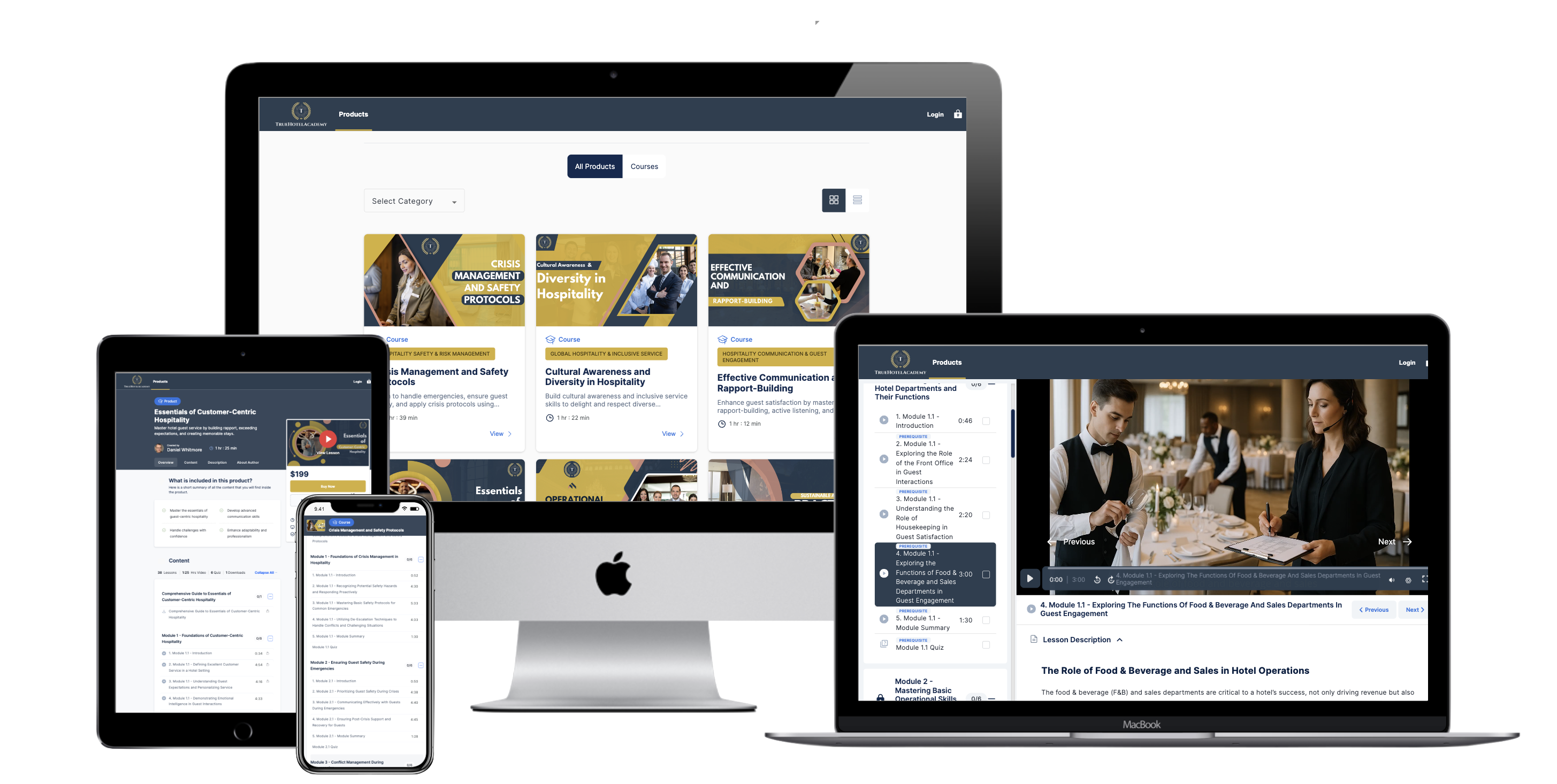
The Complete Hotel & Guest Service Mastery Bundle provides the structured training system that great hotels use to systematize service excellence. It covers everything outlined in this article: customer-centric hospitality, communication and rapport-building, operational fundamentals, crisis management, cultural awareness, sustainability practices, and the art of going above and beyond.
Designed for busy hotel operations teams, the bundle is self-paced, online, and immediately actionable. Your team can complete foundational training before their first shift, and experienced employees can strengthen skills without disrupting schedules. With fifteen team licenses included, your entire staff learns from the same framework and delivers the same standards.
Great hotels don't leave service to chance. They train it, reinforce it, and build systems that ensure every guest receives excellent care, regardless of who's working that day.
Your property can do the same.
Explore the Complete Hospitality Mastery Bundle and start training what you've been leaving to chance.