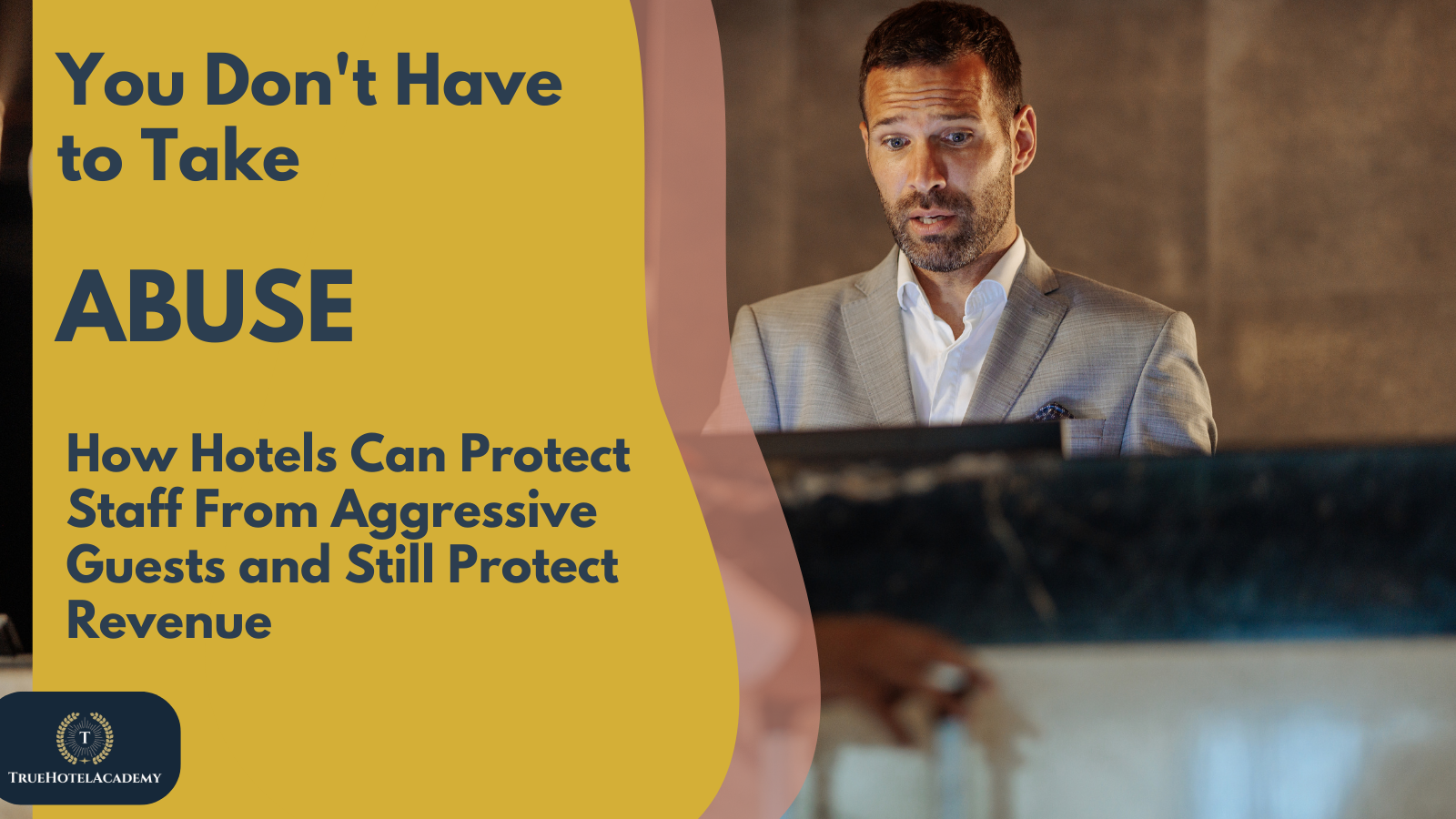
There's a moment most hotel managers remember: standing at the front desk while a guest berates your employee, and wondering if you should step in or let them "handle it."
You've probably also had a front desk agent come to you after a shift and say, "I don't get paid enough to be talked to like that." And they're right.
Somewhere along the way, hospitality became confused with submission. The idea that "the guest is always right" turned into "the guest can say or do anything, and we have to take it." That's not hospitality. That's enabling abuse.
Here's what needs to be said clearly: verbal abuse, threats, and hostile behavior are not part of the job. Your staff should not have to tolerate being screamed at, insulted, or threatened just because someone is paying for a room.
And contrary to what many hotel operators fear, protecting your team from abusive guests doesn't hurt revenue. It protects it.
Why "The Guest Is Always Right" Is Wrong

Let's retire this phrase. It was never meant to justify abuse.
The original intent was reasonable: prioritize guest satisfaction, be flexible when you can, and don't argue over small things. It didn't mean "accept any behavior, no matter how unacceptable."
But over time, it evolved into a free pass for bad behavior. Guests learned that if they yell loud enough, complain aggressively enough, or threaten a bad review, they get what they want. And hotels reinforced this by rewarding the behavior.
The problem is that this approach damages your operation in ways that aren't immediately visible on a P&L statement.
The Real Cost of Tolerating Abusive Behavior
When you allow guests to mistreat your staff without consequences, several things happen, and all of them are expensive.
Staff turnover accelerates. Good employees don't stick around to be verbally abused. They leave for properties that protect them, or they leave hospitality altogether. Now you're hiring and training replacements, which costs thousands of dollars per position and creates operational gaps that hurt service quality.
Morale collapses. When employees see that management won't stand up for them, they stop caring. Why go the extra mile for a company that won't protect you from a guest calling you incompetent over a $15 parking fee? Disengaged employees deliver worse service, which creates more guest complaints, which creates more stress for everyone.
Service becomes inconsistent. Some employees will enforce policies. Others will cave immediately to avoid confrontation. Guests learn that if they push hard enough, rules don't apply. Your policies become meaningless, and your operation becomes chaotic.
Management burns out. You spend your days managing guest escalations that shouldn't have escalated in the first place. You're constantly putting out fires, mediating conflicts, and absorbing abuse that your employees couldn't deflect because they weren't trained or empowered to handle it.
The irony is that tolerating abusive behavior doesn't even protect revenue. It just shifts where the cost shows up.
Why Hotels Tolerate Abuse (And Why That Needs to Change)

Most hotels don't want to allow abusive behavior. They do it because they're afraid of the consequences.
Fear of bad reviews. Online reviews carry weight, and one angry guest can write a scathing review that sits at the top of your profile for months. So you comp their stay, upgrade their room, and apologize for enforcing your own policies, just to avoid a one-star review.
Revenue pressure. Every room matters, especially during slow periods. The idea of refusing a guest or asking them to leave feels like turning away money you can't afford to lose.
Lack of clear escalation policies. Most properties don't have documented standards for when it's appropriate to push back on a guest, ask them to leave, or involve law enforcement. Without clear guidelines, frontline staff default to submission because it's the safest choice.
Here's the reality: protecting your staff from abuse doesn't cost you good guests. It costs you bad ones, which is not a loss.
De-Escalation vs. Submission (They're Not the Same Thing)
There's a critical difference between de-escalating a tense situation and submitting to unreasonable demands.
De-escalation means staying calm, listening actively, acknowledging frustration, and working toward a reasonable solution. It's a skill, and it's essential in hospitality.
Submission means giving in to whatever the guest demands, regardless of whether it's reasonable, just to make them stop yelling.
A guest upset about a maintenance issue in their room deserves empathy, a sincere apology, and a solution (room change, discount, future credit). That's de-escalation and service recovery.
A guest screaming at your front desk agent and calling them names because they don't like your pet policy deserves firm, professional boundaries. That's not a service failure. That's behavior management.
Training your team to recognize the difference is critical. They should know how to de-escalate when appropriate and how to hold boundaries when necessary.
Service Recovery vs. Rewarding Bad Behavior
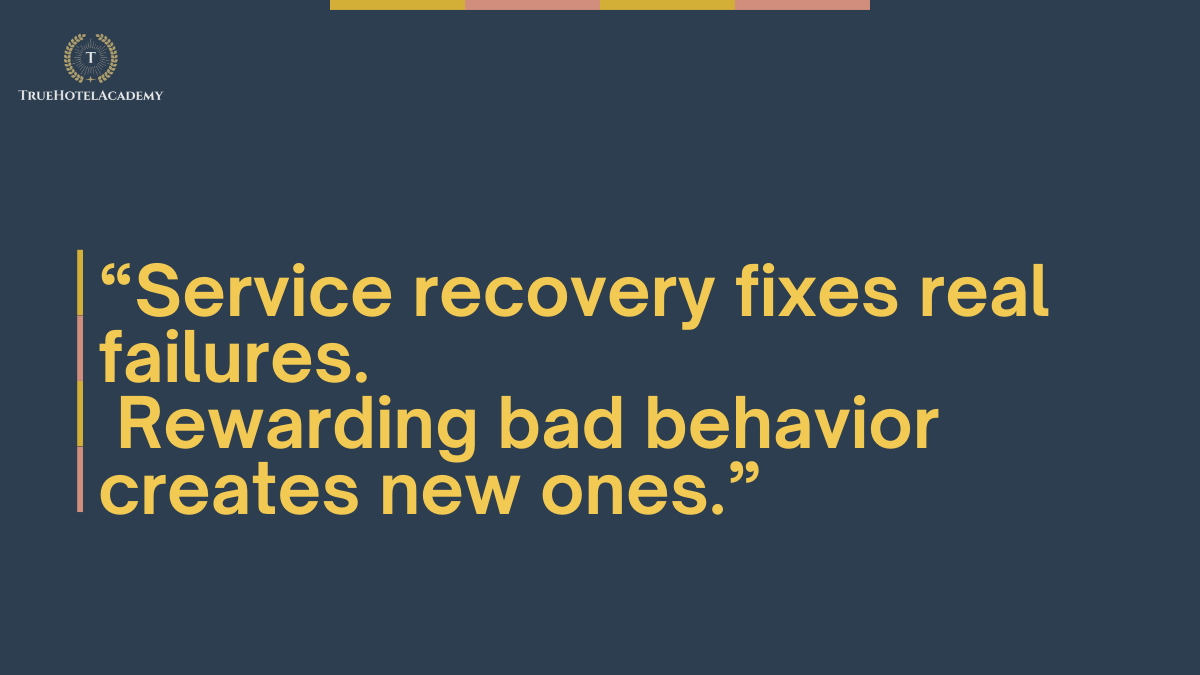
Service recovery is what you do when your property genuinely fails a guest. Their room wasn't ready. Housekeeping missed something. A system error caused a billing issue. These are real problems that deserve real solutions: apologies, compensation, follow-up.
Rewarding bad behavior is what happens when you comp a stay for a guest who was never actually wronged, just loud.
Here's an example. A guest checks in and immediately complains that the room "smells funny" (it doesn't). They demand a suite upgrade. Your agent offers a comparable room. The guest refuses and starts raising their voice, saying this is "unacceptable service" and they'll "tell everyone" about your property.
If you give them the suite, you've just taught them that aggression works. They'll do it again. And they'll tell other guests that this tactic works.
If your agent calmly offers reasonable alternatives, explains the options, and holds the line professionally, the guest either accepts a fair solution or leaves. Either outcome is better than rewarding hostility.
Real-World Scenarios and How to Handle Them
Let's get specific. Here are common situations where staff often feel pressured to tolerate abuse, and what should happen instead.
Rate disputes at check-in. A guest insists they booked a lower rate than what's in your system. They get loud, accuse your agent of lying, and demand you honor "their" price.
What should happen: Your agent verifies the reservation calmly, shows the confirmation (if available), and explains the rate on file. If the guest continues to be hostile, management steps in, confirms the same information, and offers the guest the choice to accept the rate or cancel with no penalty. If they become abusive, you ask them to leave.
Policy enforcement (ID, deposits, check-out times). A guest refuses to provide a credit card for incidentals and says, "I've stayed at hundreds of hotels and never had to do this." They escalate to yelling when your agent insists.
What should happen: Your agent calmly explains that the policy applies to all guests and is non-negotiable. If the guest continues to argue or becomes verbally abusive, management reinforces the same message. No exceptions, no apologies for enforcing your own rules.
Noise complaints and evictions. A guest is causing repeated disturbances. Other guests are complaining. You knock on their door to address it, and they become hostile, threatening, or uncooperative.
What should happen: You set clear expectations: the behavior stops now, or they're asked to leave. If they refuse or become threatening, you involve law enforcement. This isn't about being harsh. It's about protecting the other 50 guests who deserve a safe, quiet stay.
Building Clear Boundaries and Consistent Language

Staff need to know what's acceptable to say and do when a guest crosses a line.
Boundaries should be documented and reinforced in training. For example:
"Guests may not yell at, insult, or threaten staff. If a guest becomes verbally abusive, the employee will calmly disengage and involve management."
"Management will address the situation professionally. If the guest continues the behavior, they will be asked to leave."
Consistent language matters too. Train your team to use phrases like:
"I understand you're frustrated. Let's work on a solution."
"I'm happy to help, but I need you to speak to me respectfully."
"I'm going to step away and have my manager continue this conversation."
When everyone uses the same approach, it's harder for guests to escalate or manipulate the situation.
How Training Builds Confidence and Protects Revenue
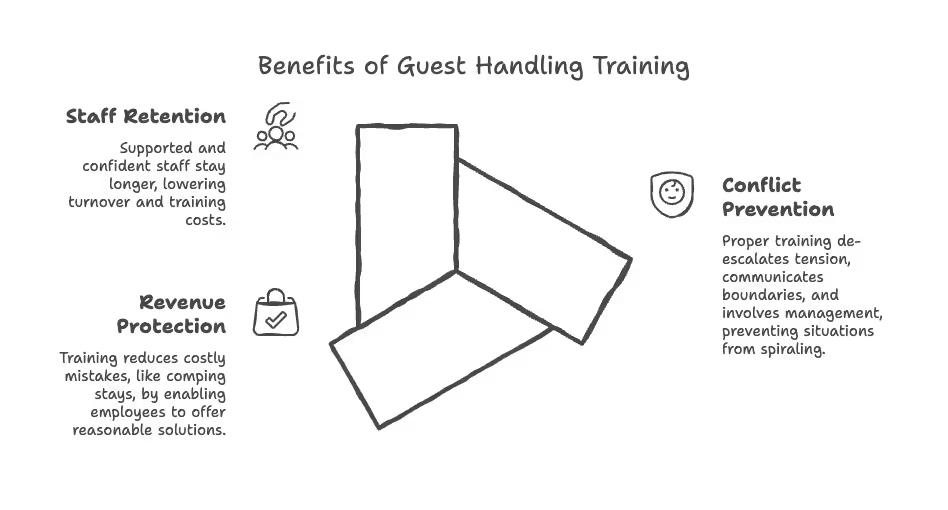
Here's the part most hotel operators miss: proper training in handling difficult guests doesn't create conflict. It prevents it.
When your team knows how to de-escalate tension, communicate boundaries, and involve management appropriately, fewer situations spiral out of control. Guests respect professionalism and confidence. They push back against hesitation and fear.
Training also protects revenue because it reduces costly mistakes. An untrained employee might comp an entire stay to stop a guest from yelling, costing you hundreds of dollars. A trained employee knows how to offer a reasonable solution that satisfies the guest without giving away the store.
And when staff feel supported and confident, they stay longer. Lower turnover means lower hiring and training costs, better service consistency, and a stronger team culture.
Making the Shift

If your property has been operating under the "accept all behavior to avoid conflict" model, changing course takes intention.
Start by making it clear to your team that they don't have to tolerate abuse. Back that up with policies, training, and visible management support.
The Complete Hotel & Guest Service Mastery Bundle includes comprehensive training on handling difficult situations, de-escalation techniques, professional communication, and crisis management. It gives your team the skills and confidence to navigate conflict without submission and the framework to protect both guest satisfaction and staff dignity.
The bundle covers effective communication and rapport-building, service recovery principles, and operational fundamentals that reinforce consistent standards across your property. It's designed for the real situations your team faces daily, not theoretical scenarios.
When your staff is trained properly, they handle conflict better, feel more supported, and deliver more consistent service. That's not a soft skill. That's risk management.
Explore the Complete Hospitality Mastery Bundle and see how structured training transforms the way your team handles difficult guests without sacrificing professionalism or revenue.
You don't have to choose between protecting your staff and protecting your business. With the right systems and training, you protect both.